
Lung sliding on ultrasound
Lung sliding is the shimmer of the pleural line as the visceral pleura moves against the parietal pleura with each breath. If you can see it, the lung is touching the chest wall at that spot — which rules out pneumothorax there.
Live simulator — try itFull interactive lesson →
Finding the pleural line
Place a linear probe longitudinally across two ribs on the anterior chest. The ribs cast black shadows; between them, slightly deeper than the rib tops, is the bright pleural line. Together they make the “bat sign”.
Seeing the slide
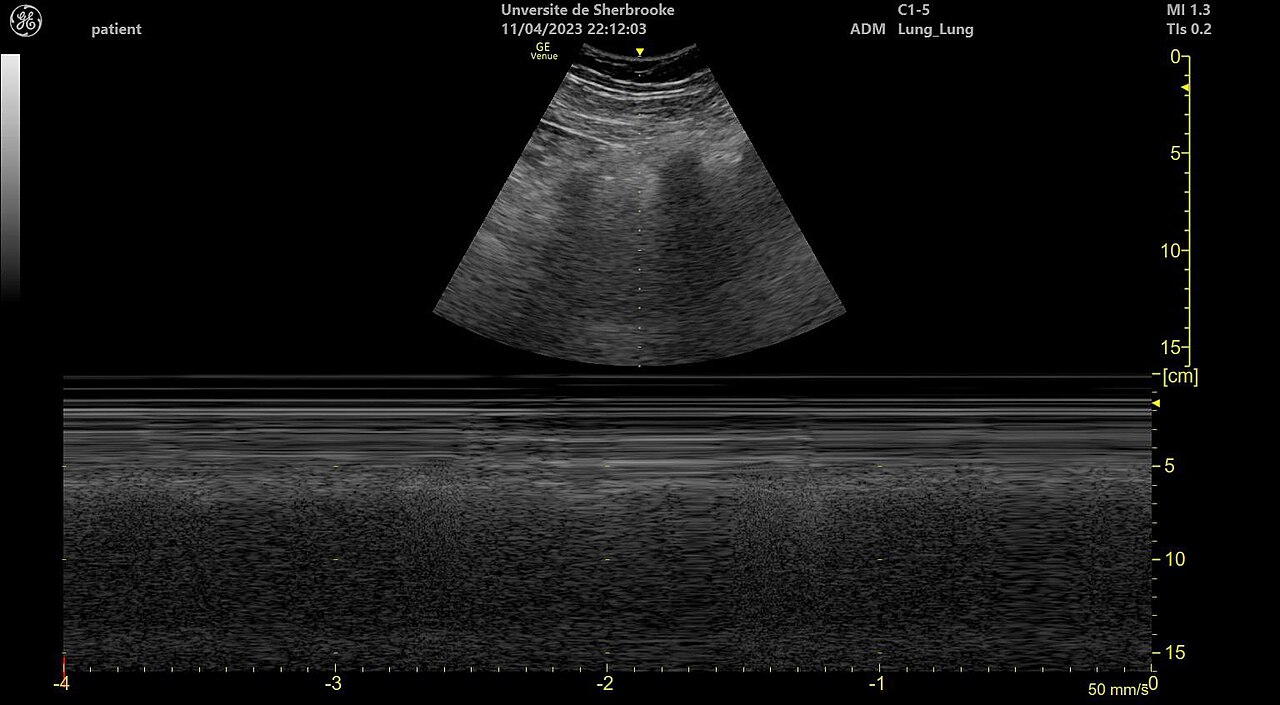
Hold perfectly still and watch the pleural line: normal lung shimmers back and forth (“ants marching”). In M-mode through the pleura, normal lung gives the seashore sign — still horizontal lines above, grainy “sand” below.
When sliding is absent
No sliding suggests pneumothorax, but is not specific: apnoea, mainstem intubation, pleural adhesions and severe lung disease also abolish it. The lung point — where sliding and non-sliding lung meet — confirms pneumothorax.
Real scans
Learn this with your hands. Sonoduck gives you a 3D patient, a probe and a coach that tells you what to do. Free to start, no signup.
Scan your first patientFAQ
Which probe is best for lung sliding?
A high-frequency linear probe for the pleural line; a curvilinear probe also works and sees deeper.
What is the barcode sign?
M-mode without sliding: horizontal lines all the way down, also called the stratosphere sign.
Related guides
- Diagnosing pneumothorax with ultrasoundUltrasound signs of pneumothorax: absent lung sliding, absent B-lines, barcode sign and lung point. Where to scan and the common false positives.
- A-lines vs B-linesThe difference between A-lines and B-lines on lung ultrasound, how many B-lines are abnormal, and what they mean — with real images and a live simulator.
- Pleural effusion on ultrasoundHow to find a pleural effusion with ultrasound: the flank view, anechoic fluid above the diaphragm, the spine sign and floating lung. Live simulator and real clips.
Educational content for learners; follow local protocols and supervision. Simulated images are generated by Sonoduck’s physics model; real images are credited individually.